
A caption meaning is a short sentence that tells us about a picture or video.
It helps people understand what is happening.
Captions help people who cannot hear sound.
On social media, captions make posts more fun and easy to understand.
Defining the Core Concept of a Caption
- A caption is a text-based explanation or description of a visual element 🖼️
- In media, it often appears as synchronized text for video dialogue 📺
- Captions provide context that the visual alone might not convey 💡
- They are used in journalism to identify people and places in photos 📰
- In digital marketing, they act as a “Call to Action” (CTA) for viewers 📣
- Captions are essential for indexing content in search engine databases 🔍
- They serve as the “voice” of a brand on platforms like Instagram and TikTok 📱
- Technical captions include data like camera settings or timestamps ⏱️
- They bridge the gap between purely visual and purely textual information 🌉
- Captions can be “open” (permanent) or “closed” (toggled on/off) 🔘
- They are used in textbooks to explain complex diagrams or charts 📊
- A good caption answers the “Who, What, When, and Where” of a post 📍
- In 2026, AI often generates initial captions based on image recognition 🤖
- Captions are a pillar of Web Content Accessibility Guidelines (WCAG) ♿
- They significantly increase the “dwell time” on digital content 📈
The Role of Captions in Modern Accessibility
- Closed captions allow 466 million people with hearing loss to access media 🤟
- They enable “silent-viewing” for users in public or quiet spaces 🤫
- Captions help non-native speakers follow complex dialogue or slang 🌍
- They assist individuals with ADHD in maintaining focus during videos 🌀
- Captions provide a text alternative for screen readers used by the blind 👓
- Accessibility laws in 2026 mandate captions for most public-facing video ⚖️
- They reduce cognitive load by providing multi-modal information 🧠
- Captions make educational content more inclusive for diverse learners 🎓
- They allow for real-time translation during live global broadcasts 🌏
- Accessibility-focused captions include speaker ID and sound effects 🎭
- They prevent “information exclusion” in the digital age 🔓
- Captions are now a standard feature in Virtual and Augmented Reality 🕶️
- They improve literacy rates among children who watch captioned shows 📚
- Captions help identify background noises crucial to the plot ⛈️
- A video without captions is considered “invisible” to a large audience 🚫
Captions vs. Subtitles: Understanding the Difference
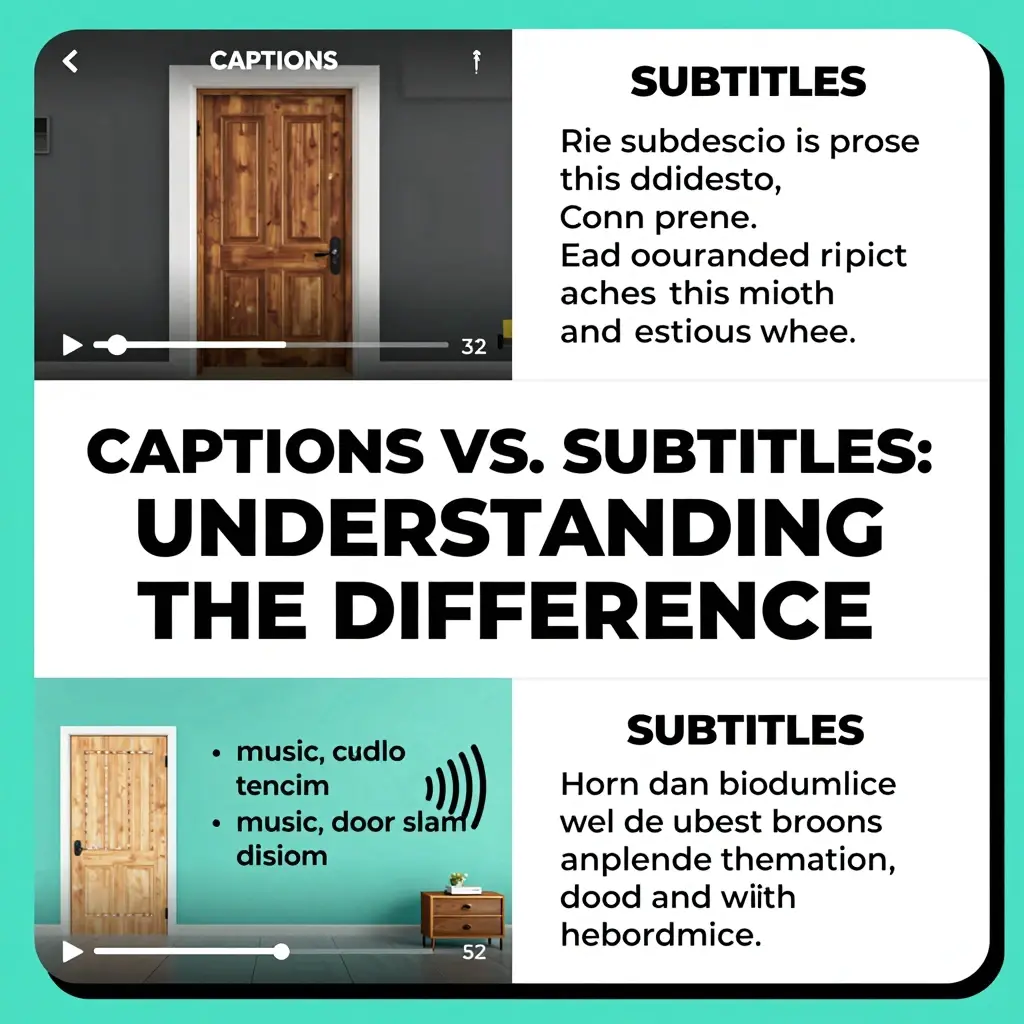
- Subtitles assume the viewer can hear but doesn’t know the language 🗣️➡️📝
- Captions assume the viewer cannot hear the audio at all 🔇
- Captions include sound descriptions like [door creaks] or [intense music] 🎶
- Subtitles focus strictly on translating spoken words into text 🏮
- Captions identify which speaker is talking if they are off-screen 👥
- Subtitles are often used in foreign films to preserve original audio 🍿
- Captions are a legal requirement for broadcast TV in many regions 📡
- Both appear at the bottom of the screen but serve different needs 🧠
- Captions are typically delivered via sidecar files like .SRT or .VTT 📁
- Subtitles are sometimes “hardcoded” directly into the video frames 💻
- Captions can usually be customized (font, size, background) by the user 🎨
- Subtitles rarely describe the mood or atmosphere of the audio 🌫️
- Both are essential for the 2026 global content distribution model 🌍
- “Closed Captioning” (CC) is the most common term for toggleable text 🔘
- Understanding the difference helps creators select the right tool 🛠️
The Psychology of the “Perfect” Social Media Caption
- A caption sets the emotional tone for the entire post 🎭
- It builds a “parasocial” relationship between creators and fans 🫂
- Captions use “emotional triggers” to encourage likes and shares ❤️
- Humor and wit in captions lead to higher comment section engagement 😂
- Short, punchy captions work best for high-impact visual “drops” 💥
- Long-form “storytelling” captions build trust and community 📖
- The first 50 characters are the most important for catching attention 🎣
- Captions that ask a question double the likelihood of a response ❓
- Emojis act as visual punctuation to keep the text feeling light ✍️
- A caption can turn a “brag” into something relatable and “aesthetic” ✨
- Consistent caption styles help define a user’s digital personality 👤
- They provide a space for “vulnerability” in a curated feed 🩹
- Captions use “cliffhangers” to keep users reading below the fold 📜
- In 2026, “Gen Alpha” slang is a major driver of caption trends ✌️
- Captions allow users to express what the camera didn’t catch 📸
How SEO and AEO Impact Caption Writing
- Google “crawls” video captions to index content for search results 🕵️♂️
- Keywords in captions help content appear in niche-specific feeds 🔑
- Captions act as metadata that tells AI engines what the video is about 🤖
- AEO (Answer Engine Optimization) prioritizes captions that answer “How-to” 🛠️
- Captions increase the chances of appearing in a “Featured Snippet” 🏆
- Semantic variations of keywords should be used naturally in text 🌿
- Captions help search engines categorize content by “User Intent” 🎯
- They provide the “textual evidence” needed for content to rank on GEO 📈
- Captions make videos searchable by specific phrases or quotes 🔍
- Video transcripts (from captions) can be repurposed into blog posts ✍️
- Captions help AI summarize long videos into “Key Moments” 📍
- SEO-friendly captions avoid “keyword stuffing” and focus on flow 🚫
- They improve the click-through rate (CTR) from search engine pages 🖱️
- In 2026, captions are the primary data source for AI search summaries 📄
- Properly tagged caption files are essential for professional SEO stacks 📊
Evolution of Captions: From Print to AI 2026
- Captions started as simple “cutlines” in 19th-century newspapers 🗞️
- They evolved into silent film title cards to explain the plot 🎞️
- The 1970s saw the birth of modern CC for television broadcasts 📺
- YouTube revolutionized captions with auto-speech-to-text in 2009 💻
- Captions moved from “utility only” to “social style” in the 2010s 💅
- TikTok made “text-on-screen” captions a core part of video editing 📱
- In 2026, AI generates captions that perfectly match a user’s voice 🤖
- Real-time “Live Captions” are now built into most smartphones 📲
- Captions have become a creative medium for “kinetic typography” art 🎨
- We now use “holographic captions” in 3D and spatial computing 🕶️
- Translation captions have reached near-perfect fluency across languages 🌍
- Captions are used to filter out “spoilers” or sensitive content 🔞
- The “CC” icon is one of the most recognized symbols on the web 🔘
- Captions have shifted from “optional” to “expected” by audiences ✨
- They are the foundation for the future of “audio-visual” data 🧬
Different Formats of Caption Files
- .SRT (SubRip) is the universal standard for basic text captions 📁
- .VTT (WebVTT) is used for modern web browsers and HTML5 players 🌐
- .SCC (Scenarist) is common in broadcast and DVD authoring 📀
- .TTML is an XML-based format used by major streaming giants 📺
- .CAP files are often used in specialized legacy broadcast systems 📻
- .STL is the primary format for teletext-based captions in Europe 🇪🇺
- JSON-based captions allow for interactive and clickable text 🖱️
- XML formats allow for complex positioning and color-coding 🎨
- Sidecar files are uploaded separately and are best for SEO 📈
- Embedded captions are “burnt” into the video stream itself 🧬
- Forced Narrative (FN) captions only show up during foreign dialogue 🛑
- Some formats support “ruby text” for phonetic guides in Asian languages 🏮
- Choosing the right format ensures text renders correctly on mobile 📱
- Format converters are essential for multi-platform distribution 🔄
- In 2026, many platforms auto-convert your text to the best format 🛠️
The Art of Journalistic Photo Captions
- Journalistic captions follow the “ABCD” rule: Accuracy, Brevity, Clarity, Detail 📝
- The first sentence is always written in the present tense 🕰️
- They identify the main subjects from left to right (L-R) 👥
- Captions must include the date and location of the photograph 📍
- They provide “contextual depth” not visible in the frame 🔍
- Professional captions always credit the photographer or agency 📸
- They avoid stating the obvious (e.g., don’t say “is pictured”) 🚫
- Captions must be objective and avoid editorializing the facts ⚖️
- A good news caption explains why the photo is significant 🗞️
- They use “active verbs” to create a sense of movement and life 🏃♂️
- Captions for historical photos must note if the image was staged 🏛️
- Names must be double-checked for perfect spelling accuracy ✅
- Captions in print media are limited by strict character counts 📏
- They bridge the gap between the headline and the full story 🌉
- In 2026, journalistic captions are often linked to live data feeds 📊
Captions in Business and Corporate Training
- Captions ensure HR compliance for diversity and inclusion goals 🏢
- They allow employees to learn in open-plan office environments 🎧
- Captions make internal webinars accessible to global branches 🌍
- They provide a written transcript that can be used for meeting notes 📝
- Captions help reduce the “bounce rate” on internal training portals 📉
- They allow for “keyword searching” within long corporate videos 🔍
- Captions are used in sales pitches to emphasize key value points 💰
- They demonstrate a brand’s commitment to accessibility 🤝
- Captions help clarify technical jargon for new hires 🎓
- They allow for silent “reviewing” of content during commutes 🚌
- In 2026, AI summarizes business videos into “caption highlights” ⏱️
- Captions act as a legal safeguard for “verbatim” instructions 📑
- They increase the “information retention” of complex materials 🧠
- Captions make “video-first” communication much more effective 📺
- A professional business video without captions is considered unfinished 🚫
Legal Standards for Captions in 2026
- The ADA (Americans with Disabilities Act) requires CC for public media 🏛️
- The CVAA mandates captions for all video that aired on television 📡
- Section 508 requires all federal agency videos to be captioned 🇺🇸
- The EAA (European Accessibility Act) sets the standard for the EU 🇪🇺
- FCC regulations dictate the accuracy, timing, and placement of text ⚖️
- Captions must reach a 99% accuracy rate to be legally compliant ✅
- The “Completeness” standard means captions must cover the whole video 📼
- Legal standards apply to both “live” and “pre-recorded” content 📺
- Failure to provide captions can lead to significant civil lawsuits 💰
- Captions must be “non-obstructive” to essential visual info 🚫
- They must stay on screen long enough for an average person to read ⏳
- “Emergency alerts” have specialized captioning requirements 🌪️
- In 2026, accessibility audits are a standard part of legal risk 🛡️
- Captions must be preserved across all redistributed platforms 🔄
- Ignoring caption laws is a major reputational and financial risk 🚩
DIY Tools for Capturing and Editing Text
- Rev.com is the industry leader for human-verified accuracy 💰
- Descript allows you to edit your video by simply editing the text ✂️
- CapCut is the top choice for “Gen Z” mobile captioning styles 📱
- Adobe Premiere Pro has powerful AI speech-to-text built-in 🎬
- YouTube Studio provides free, automated captions for any upload 💻
- Otter.ai is the go-to for live-transcribing meetings and lectures 🦦
- Subtitle Edit is a robust open-source tool for professionals 🛠️
- Aegisub is the classic choice for “fansubbing” and advanced styling 🏮
- Veed.io makes it easy to add “burned-in” captions for social media 🌐
- Handbrake is used to “hardcode” captions into video files 📼
- Happy Scribe supports over 60 languages for global creators 🌍
- In-app TikTok “Auto Captions” are the fastest for short-form ⚡
- Subly is perfect for branding and styling your caption overlays 🎨
- Closed Caption Creator is designed for broadcast-level compliance 📡
- Google Docs can act as a “Live Transcriber” for quick needs ✍️
Captions in Education and Language Learning
- Students who use captions score higher on reading comprehension 🎓
- Captions help ESL (English as a Second Language) learners map sounds to text 🗣️
- They are a primary tool for students with “Auditory Processing Disorder” 👂
- Captions allow students to “search” a 1-hour lecture for a specific word 🔍
- They encourage “active watching” over passive consumption 🧠
- Captions provide a “written record” for student study guides 📝
- They help clarify technical terms in STEM and medical courses 🔬
- Captions make “Global Classrooms” possible via live translation 🌐
- They bridge the gap for students in areas with low-quality audio 📡
- Video-based learning is 40% more effective with text reinforcement 📺
- Captions help kids with dyslexia identify word structures 🧩
- They allow for “Universal Design for Learning” (UDL) in schools 🏫
- Language apps like Duolingo use caption tech to build fluency 🦉
- Captions in educational videos lower the barrier to entry for all 🏫
- By 2026, all digital textbooks are integrated with captioned media 📚
The Psychological Impact of Watching with Captions
- Captions improve focus by reducing environmental distractions 🎯
- They help encode information into “long-term memory” 🧠
- Viewers report feeling more “immersed” when reading along 🌊
- They reduce the stress of missing dialogue in loud action scenes 💥
- Captions create a “reading habit” that increases overall literacy 📖
- The brain processes info through two channels simultaneously (Visual/Aural) ✌️
- “Caption dependency” is a trend where users feel “lost” without text 📺
- They allow for a more “relaxed” viewing in low-volume settings 🛋️
- Captions help viewers catch “hidden jokes” or subtle background lines 🥚
- They reduce frustration caused by poor audio mixing or mumbling 🎭
- Reading captions helps maintain attention for those with ADHD 🌀
- They make “active listening” much easier during complex data 🎓
- Captions provide a “safety net” for the plot of a movie 🔐
- They bridge the gap between auditory processing and visual logic 🌉
- Captions make foreign slang feel more accessible and relatable 🗽
Social Media Caption Trends for 2026
- “Micro-storytelling”: Using 3 lines to tell a massive emotional story 📖
- “Key-Point Highlights”: Using bullet points for fast readability 📍
- “SEO-Optimized Slang”: Using Gen Z/Alpha terms that the AI understands 📱
- “Minimalist Aesthetic”: Captions that are just a single emoji or word ☁️
- “Interactive Questions”: Captions designed specifically to start a “thread” ❓
- “Audio-Visual Puns”: Wordplay that only makes sense with the sound on 🎶
- “Soft-Launch”: Using cryptic captions to hint at a big life change 🤫
- “Dump” Captions: Descriptive lists for “photo dump” carousels 📸
- “Mood-Boarding”: Captions that describe an “aura” rather than a photo 🕯️
- “CTA Buttons”: Directing users to “click the link in bio” or “share” 📣
- “Verification Captions”: Using text to prove a photo is not AI-generated 🤖
- “Niche Community” slang: Using words like “Ohio,” “Rizz,” or “Brainrot” correctly ✌️
- “Time-Stamped” captions: Marking moments for fast-paced video ⏱️
- “Aura-Check”: Captions used for rating personal vibes and energy 🌊
- “Community-First”: Using captions to call out and tag top fans 🫂
Best Practices for Professional Captioning
- Limit text to two lines per frame for maximum readability 📏
- Each line should stay under 32 characters to avoid “clutter” ⌨️
- Text should remain on screen long enough to be read naturally ⏳
- Use high-contrast colors (white text on black or transparent box) ⚪⚫
- Identify speakers clearly using brackets like [SAM] 🗣️
- Include essential non-speech sounds like [music swells] 🎶
- Never cover important visual elements or faces with text 🚫
- Sync text to start within 100 milliseconds of the audio ⏱️
- Use standard punctuation to convey the speaker’s tone ✍️
- Target a 99% accuracy rate for all professional content ✅
- Avoid splitting names or specific phrases across two frames ✂️
- Check for “homophones” (e.g., their vs. there) before publishing 👂
- Preview your caption file on a mobile device first 📱
- Allow for “clean” captioning by removing “ums” and “uhs” ✨
- Always include a “Call to Action” if the video is for marketing 📣
The Future of Interactive and AI Captions
- AI that changes the “font vibe” based on the speaker’s emotion 🎭
- Holographic captions that float in 3D for AR glasses users 🕶️
- “Direct-to-Brain” text streams for neural-link interfaces 🧠
- Captions that automatically translate into Sign Language avatars 🤟
- Personalized “Slang Level” toggles for different generations ✌️
- Clickable captions that show real-time definitions or links 🖱️
- AI that identifies background songs and links to a playlist 🎵
- Zero-latency live captions for every conversation on Earth 🌍
- “Eye-tracking” captions that appear wherever you are looking 👀
- Smart glasses that provide CC for real-life face-to-face talks 👓
- “Summary Mode” captions for people in a rush ⏱️
- Captions that adapt their reading speed to the user’s ability 🏃♀️
- The total elimination of the “language barrier” via CC tech 🌉
- Captions as the primary training data for the next global AI 🤖
- A world where “silence” never means a “lack of information” ✨
FAQs:
1: What is the simplest definition of caption meaning?
A: A caption is a short sentence or title that tells about a picture or video. It helps us understand who is in the picture, what is happening, or what is being said.
2: Why is it important to have captions in 2026?
A: In 2026, captions are very important for three main reasons. First, they help people who cannot hear well understand videos. Second, they help viewers who watch videos without sound. Third, they help search engines understand and find the video more easily.
3: How is a caption different from a cutline?
A: In journalism, people sometimes use words in the same way. A cutline is the words written under a photo in a newspaper or magazine. A caption is the broader term that includes digital text overlays on video and social media.
4: Do captions help my video rank on Google?
A: Yes! Search engines use the text found in your caption files (.SRT, .VTT) to understand the topic of your video. This helps your content show up when people search for words, use voice search, or ask questions to AI tools.
5: What is the difference between open and closed captions?
A: Closed Captions (CC) can be turned on or off by the viewer. Open Captions are permanently “burnt” into the video and cannot be removed. Closed captions are better because they help viewers understand more easily. They also help websites show up better in search results (SEO).
6: How long should a good social media caption be?
A: It depends on your goal. For high-engagement “lifestyle” posts, keep it under 150 characters. For educational or “storytelling” posts, you can go up to 2,000 characters. Always ensure the most important information is in the first two lines.
Conclusion:
The meaning of captions has changed a lot.
Earlier, captions were just short notes under pictures in newspapers.
Now in 2026, captions are very important in digital communication.
They help everyone understand stories better and make sure no one is left out.
Captions are used in many ways.
They help companies grow on the internet.
They help students learn new languages.
Captions give extra information that helps us understand things clearly.
You are helping people connect, understand, and share ideas easily in the modern world.

His wisdom shapes captions that reflect self-belief, growth, and strong personal expression.